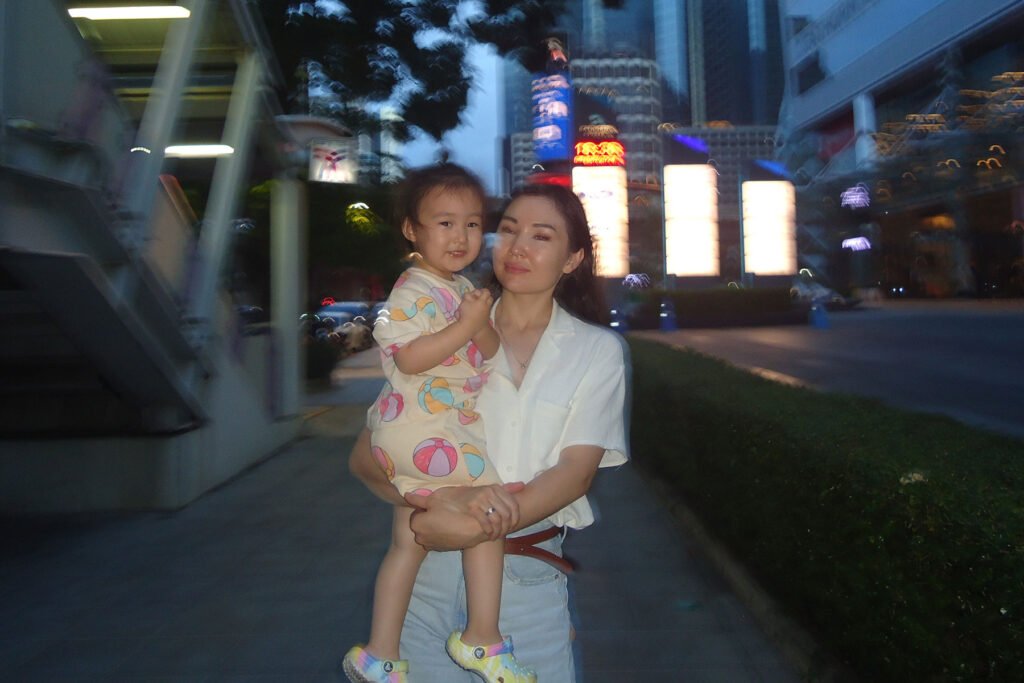
Years ago, I remember giving advice to mothers who told me they wanted to draw but couldn’t find the time. “Draw while the baby is sleeping.” I had no idea what I was talking about. I thought the problem was time. Surely somewhere in the day there were twenty minutes that could be found for drawing. What I didn’t understand was what it feels like when your mind is occupied by another human being almost all the time. Or what it means to be physically tired in a way that a good night’s sleep doesn’t necessarily fix. I didn’t know how much of yourself motherhood could require.
Those women were already making and growing something. A personality. Another human being. When I became a mother myself, I didn’t manage to find the beautiful balance I might have imagined before having a child. FSketcher became quiet. Drawing became occasional. There were long stretches when I had neither the energy nor the desire to make anything. For some time, I resisted it. I felt that I should somehow be able to do both.
Eventually, acceptance brought much more relief than resentment ever did. This was simply a different season of my life. I knew I would come back. In the meantime, I had become a teacher to one very small apprentice. That thought gave me peace.
The work you cannot see
There are many reasons why a person might have to put making aside. A baby is one of them. Caring for elderly parents might be another. An accident. Illness. Moving countries. Financial problems. Grief. Sometimes life puts something in front of you that deserves your attention more than your creative ambitions do.
I used to think that time away from drawing meant falling behind. Now I’m not so sure. During those years I had less time to create and much more time to observe and reflect. And somewhere in that period I discovered something that still fascinates me: when you become stronger as a person, that strength somehow finds its way into everything you do. It is as if the whole system gets upgraded.
Motherhood made this very personal for me because suddenly my behaviour was no longer entirely my own business. There was a little person watching. I began thinking about what I was showing her. If I spent my life complaining, blaming other people, feeling ashamed of myself and afraid of everything, she would absorb some of that. Children learn so much from watching us live. I wanted to give her a better example.

With the support of my partner, I went to therapy. I read. I did the practices. I looked back at situations that had bothered me for years and tried to understand why I had behaved the way I did. I questioned habits that I had always considered part of my personality. There was a tremendous change.
As Shrek wisely said, we are multilayered. I removed quite a few layers. There are probably plenty left. I am still curious about what is underneath.
The surprising part was that work I had done to become a better mother eventually followed me back into my craft. I had always assumed that becoming better at drawing required drawing more. Of course practice matters. It matters enormously. But I no longer think our skills live in separate little rooms inside us. The person holding the pencil matters too.
Patience matters. The ability to look closely matters. The courage to make a decision and leave it there matters. Self-respect matters. Curiosity matters. Even responsibility matters. When I returned to my work, I could see things differently. I could understand my own drawings better. I could look at them without immediately searching for everything that was wrong. That might have been one of the biggest changes of all.
A quieter voice
My inner critic used to be very effective. It knew exactly where to press. Someone was more successful. Someone had better drawings. Someone had achieved more at my age. Someone had a larger audience. Someone had managed to turn their work into something impressive while I was still moving in circles.
For years I confused that voice with ambition. I thought perhaps it was useful. Maybe constantly reminding myself that I wasn’t good enough would keep me moving. Mostly, it poisoned things I loved.
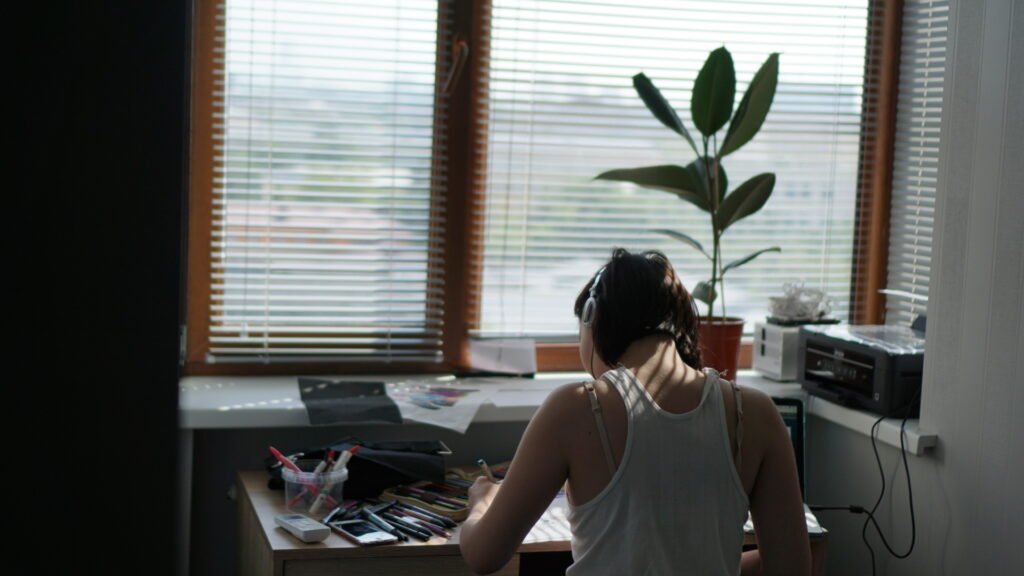
The voice is still there. I don’t think these parts of ourselves disappear so neatly. I simply know it now. And there is another voice that has become stronger. It says: I can.
There is room in this world for other people’s work and there is room for mine. My daughter has a place here. I want her to grow up knowing that without question. Somewhere along the way I realised that I have to believe the same thing about myself.
Finding the reason
People have been trying to understand happiness for thousands of years. Buddhists contemplated it. Philosophers built entire systems around it. We still buy books trying to figure it out. Perhaps one of the oldest answers has been purpose: having something worth giving ourselves to.
When FSketcher started, it was mostly fun for me. I enjoyed drawing. I enjoyed sharing what I knew. I was happy when people liked my work. Helping people felt good, and, if I am being fair to my younger self, being admired felt good too. There was nothing particularly wrong with that. But I didn’t really respect what I was doing. I didn’t respect my drawings either.
FSketcher grew in the same way I worked: spontaneously, enthusiastically and without much structure. I would make something, disappear, return with another idea, disappear again. I didn’t understand what the larger purpose of the project could be because I hadn’t yet understood my own.
Only now do I remember some of the messages differently. Someone wrote that they became a fashion designer after learning from FSketcher tutorials. Someone found peace in drawing. Someone watched my tutorials while recovering from a car accident and told me they had brought some relief into a difficult period. I read those messages years ago. I was grateful. I probably replied and then continued with my day.
Today they bring tears to my eyes. I finally understand what they were telling me.
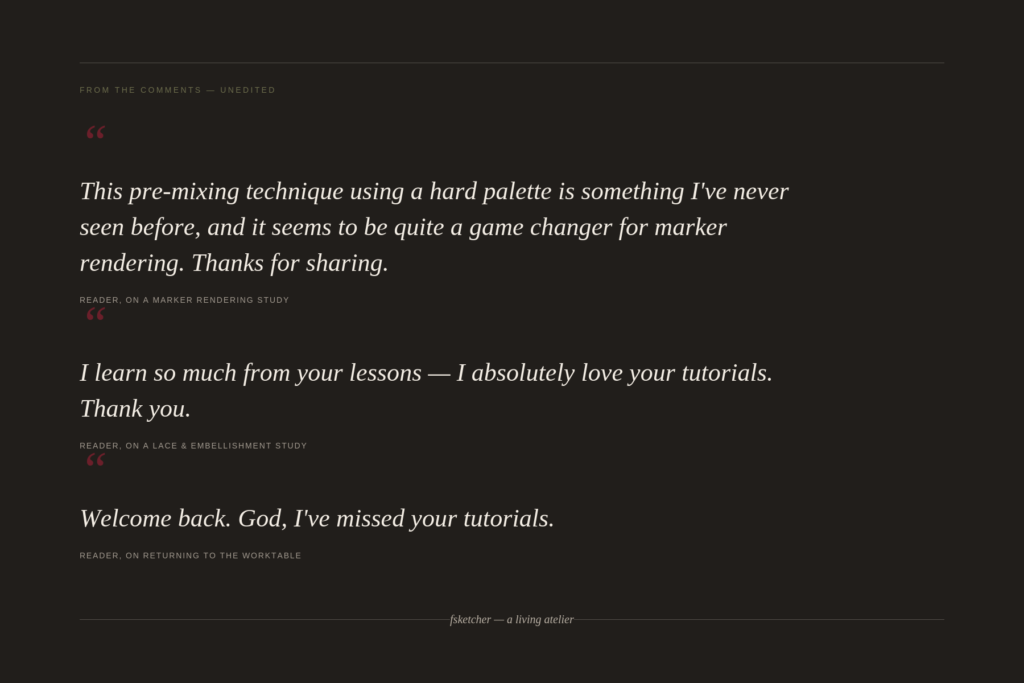
A drawing tutorial is a very small thing in the enormous scale of a human life. But sometimes a small thing reaches someone at exactly the right moment. Someone sits down, takes a pencil and spends an hour making something beautiful. They become absorbed in it. They learn. They notice that their hand can do something it couldn’t do yesterday. Maybe that hour matters.
This is where FSketcher makes sense to me now. And perhaps this is also what happiness in purpose means. You understand why you are doing the work, and suddenly the work carries a different weight.
Going further
I have always been fascinated by people who are almost ridiculously devoted to what they do. People who know far too much about one obscure subject. Who spend years perfecting something most people would consider good enough already. Who keep studying long after anyone expects them to.
Extraordinary contains the word extra for a reason.
Once I had some space in my routine again, I started investing heavily in my education. Sometimes almost all the money I could reasonably spare went into learning. I still think this is one of the best investments a person can make.
If there is a skill you love, learn more about it. If there is a skill that can give you independence, invest in it. Find people who know more than you. Study their work. Take classes. Read. Practise. Be slightly unreasonable about how interested you are. Because whatever you build in yourself stays with you.
Looking back, I don’t think those quieter years were empty years for FSketcher. Very little was happening on the surface. Underneath, quite a lot was changing.
I thought I had stepped away from making.
Now I think I was simply making something that couldn’t be published yet.d away from making.
Now I think I was simply making something that couldn’t be published yet.